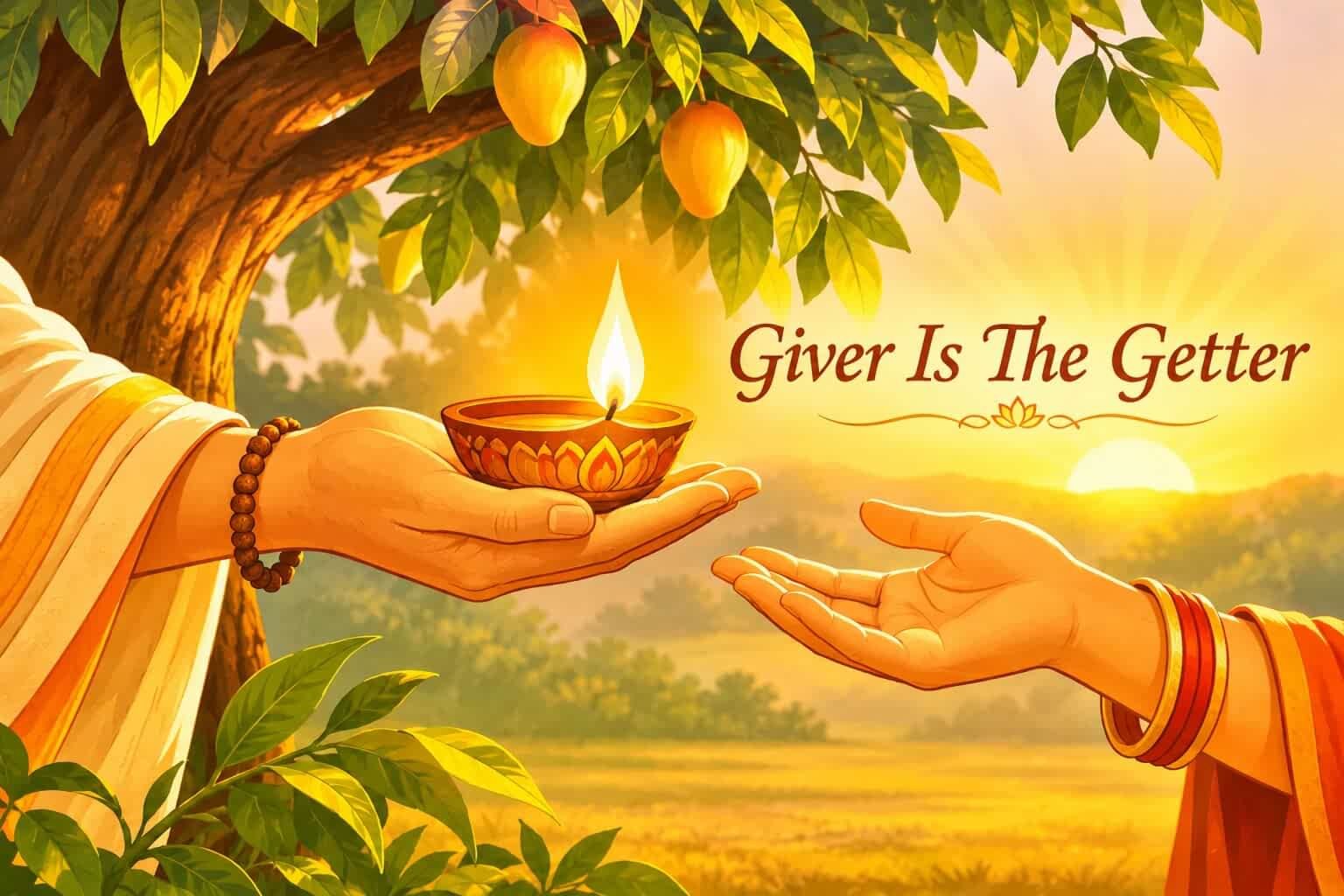
Giver Is The Getter
Giver is the getter, learn to give first.
You want more money, more love, more peace. Fair. But answer honestly: what did you give today?
Most of us stand with an upside-down bucket, asking life to pour in before we have poured out. India’s rishis saw through that trick thousands of years ago. Their answer was simple: the giver is the getter.
What Is Giving?
Giving is not charity. It is value you hand over without counting the return:
your time, honesty, skill, attention and full effort.
A shopkeeper who says, “This ₹40 notebook is enough for your child, skip the ₹200 one,” is giving. So is a mother awake beside a sick child.
Giving is the first move, never the reward.
Why Give?
Because holding on shrinks you. Water that never flows turns stale.
The Isha Upanishad packs the paradox into three words:
ईशोपनिषद् 1: “तेन त्यक्तेन भुञ्जीथाः”
त्याग के भाव से भोग करो।
“Enjoy through giving up.”
A taker lives in scarcity, so every rupee given feels like a loss. A giver lives in abundance, so every rupee circulated feels like a seed. People forget what you sold them. They remember whether you were fair.
Cause and Effect: The Law Krishna Taught
Krishna states it plainly:
गीता 3.11: “परस्परं भावयन्तः श्रेयः परमवाप्स्यथ”
एक-दूसरे को पुष्ट करते हुए तुम परम कल्याण पाओगे।
“By nourishing one another, you will reach the highest good.”
The chain is simple. You give value. Trust forms. Trust brings people back, and they bring others. Money, name and fame follow, the way a shadow follows a walker.
Look at nature. A tree gives shade, fruit and air without an invoice, yet it is the tree that receives sunlight, rain and the whole sky. Nothing grows by hoarding.
How the Giver Becomes the Getter in Business
Two shopkeepers sit on the same lane. One pushes whatever earns the biggest margin. The other asks, “What do you actually need?” and sometimes sends the customer away with a cheaper product. In a month, the first has more profit. In ten years, the second has more customers, more referrals and a name people repeat without being paid to. That is not luck. That is the law working at the counter.
In Spirit, the Same Law Goes Deeper
Give everything, including ego, fear and your last claim, and nothing is left to block grace. Then Krishna’s promise begins:
गीता 9.22: “तेषां नित्याभियुक्तानां योगक्षेमं वहाम्यहम्”
जो मुझमें अटल हैं, उनके पाने और बचाने का भार मैं उठाता हूँ।
“For those ever devoted to Me, I carry what they lack and protect what they have.”
What follows is what no market sells: His kripa, His shadow, a peace that doesn’t depend on results.
Tulsidas says it through action:
रामचरितमानस, उत्तरकाण्ड: “परहित सरिस धर्म नहिं भाई”
दूसरों की भलाई जैसा कोई धर्म नहीं।
“There is no dharma equal to doing good to others.”
Adi Shankaracharya adds the finest detail in the Vivekachudamani. Great souls live “वसन्तवल्लोकहितं चरन्तः”, like spring, doing good to the world, and help others cross life’s ocean “अहेतुना”, without any motive. Give without a motive, and the getting stops being a plan. It becomes a by-product.
Start Giving First
- Give value before you ask. Help, teach or serve without sending a bill.
- Give honestly. Recommend what fits them, not what pays you more.
- Give without keeping score. Krishna’s rule: do your part, release the result.
Giving is not being used. Give wisely, within your means, with your self-respect intact.
देने वाला ही पाने वाला है – जो देना सीख गया, उसे लेना नहीं पड़ता, वो खुद चलकर आता है।
The giver is the getter. One who learns to give doesn’t chase receiving; it walks toward him.
– okhvicky
Hence, self benefit is to remember:
Don’t ask what life owes you. Ask what you have planted.
Research Sources:
- Vivekachudamani – Adi Shankaracharya (verse 37 or 39 by edition
- Sanskrit Documents — Vivekachudamani full text
- Ramcharitmanas, Uttarkand
- Bhagavad Gita 3.11 and 9.22; Isha Upanishad, mantra 1
- SELF EXPERIENCES OF AUTHOR
.
Share to become a GIVER!