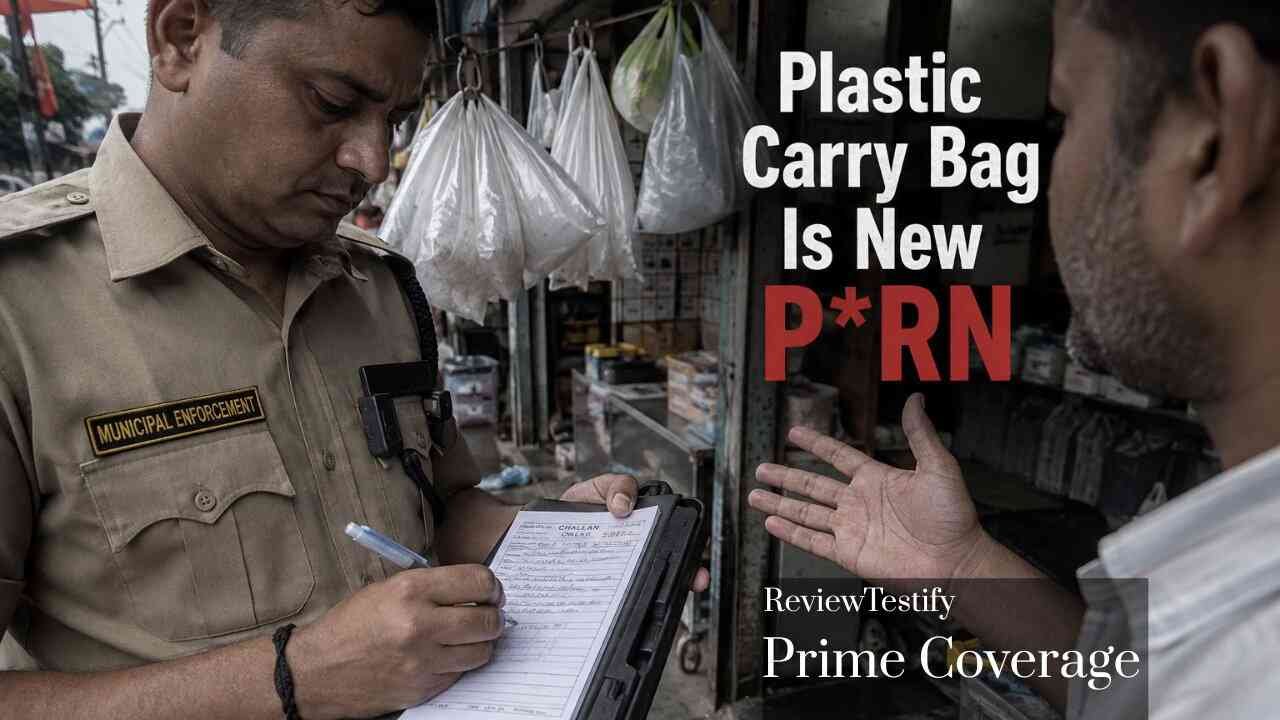
Plastic Carry Bag Is New PORN
Reason behind saying plastic carry bag is new porn is its so addictive that may be a person doesn’t watch porn for few days but using plastic carry bag 1-4 times a day is impossible these days.
Based on raw facts, figures and proven research, RT present environmental threatening coverage on use of plastic carry bags. Hold tight, read might!…
RT verdict: Everyone’s right, that’s the problem
Shops still using banned plastic
84%
Toxics Link, 2025, 560 places found.
Will the ban fix itself? — No
Fake recycling certificates found
700,000
38x recyclers’ real capacity
Signal value: high — the real leak is upstream
Cost gap: compostable vs plastic bag
5-10x
₹0.30-0.40 vs ₹1-10 per piece
You Blame the Shopkeeper for the Plastic Bag.
Here’s Who You Should Actually Be Angry At.
The Blame Is Going in a Circle, and Everyone’s Right?
Who’s actually responsible for the plastic bag in your hand right now? Ask the customer, and he’ll say it’s the shopkeeper’s job to provide one — free, obviously, that’s what shops do. Reach the shopkeeper, and he’ll tell you the customer refuses to walk in carrying their own bag and won’t buy anything if he doesn’t hand one over. Ask the manufacturer, and he’ll shrug: I only make what people order. Ask the government, and it’ll show you a ban notification from 2022 and a challan book.
Four people, four honest answers, and somehow the bag is still in your hand. That’s not confusion. That’s a circle built on purpose — because as long as everyone can point at someone else, nobody has to actually pay for the fix.
The Numbers Nobody’s Arguing About
Here’s what isn’t in dispute. India generates roughly 3.9 million tonnes of plastic waste a year — about 10,689 tonnes every single day — and recycles only 60% of it, according to CPCB’s own 2022-23 annual report. Per-capita plastic waste has more than tripled since 2016, from 700 grams a year to 2.5 kilograms. A 2025 Toxics Link survey walked into 560 shops and markets across four major cities and found banned plastic still in active, everyday use at 84% of them — Delhi came in worst, at 86%. Three years into a national ban, and the compliance rate looks almost identical to the day the ban was announced.
And here’s the number that explains why nobody’s switching: a CPCB-certified compostable bag costs a shopkeeper anywhere from ₹1 to ₹10 a piece. A banned plastic one costs 30 to 40 paise. That’s not a small gap. For a shop running on thin retail margins, it’s the difference between profit and loss on every single bag you hand out.
The Shopkeeper Isn’t the Leak.
He’s Just the Only One Getting Caught.
What ₹355 Crore in Fines Is Actually Hiding?
Here’s the part that should make you angrier than the bag ever could. While your local dukaandar is getting fined ₹5,000 to ₹25,000 for a 30-paisa poly bag, CPCB and CSE auditors uncovered over 700,000 fake plastic recycling certificates in circulation — nearly 38 times more than India’s registered recyclers could have physically issued. One recycling plant in Karnataka sold certificates claiming it had processed 3.48 lakh tonnes of plastic. The plant hadn’t even started operating.
Total fines recovered from this fraud: ₹355 crore. Against an EPR system meant to cover roughly 3 million tonnes of plastic packaging every year. Read that gap again. The government can walk into your shop and fine you before your morning chai gets cold. It took CPCB years, and outside pressure from CSE, to even find the certificate scam — and the punishment still doesn’t match the scale.
Toota hua system yeh nahi hai ki chota dukaandar bach raha hai — ulta, wahi akela pakda ja raha hai. (This isn’t a broken system where the small shopkeeper is getting away with it — he’s actually the only one getting caught.)
Four Players, Four Different Kinds of Pain
Break the chain down honestly, and each side is telling the truth about their own pain — just not about anyone else’s.
- The shopkeeper carries the cost gap and nearly all the enforcement risk, with no legal way to pass either upward. If he stops giving bags, he loses the sale to the shop next door that still does.
- The customer pays nothing extra either way — so there is zero financial reason to change, no matter how many awareness posters go up.
- The manufacturer keeps selling virgin plastic because demand hasn’t actually dropped, and can meet EPR paperwork targets by buying credits nobody bothered to verify.
- The government collects challan revenue from the visible, small, easy-to-catch violations, while the certificate fraud — the actual volume problem — barely gets prosecuted.
Every one of these four is rational. That’s what makes it so hard to fix — there’s no single villain to arrest, just four sets of incentives quietly pulling in different directions.
What Actually Changes If India Copies the UK Instead of Banning Harder!
Compare the two paths honestly — banning harder, or pricing it properly — and the difference isn’t subtle.
| Players | Pros | Cons |
|---|---|---|
| Shopkeeper | Recovers the bag cost at billing, no longer eats the penalty risk alone | New billing line, minor point-of-sale friction |
| Customer | Real cost only when not carrying their own bag | Small but real price increase |
| Manufacturer | Compostable demand grows, price gap narrows | Loses volume on cheapest virgin plastic |
| Government | Predictable levy revenue funds real audits, not just challans | Needs GST-level billing enforcement, not raids |
This Was Never a Technology Problem
You asked me once if there’s a technology that makes plastic both eco-friendly and dirt cheap at the same time. Honestly? No — and there probably never will be, because chemistry doesn’t work that way. Compostable resin exists, it works, and its price premium over virgin plastic has already fallen from roughly 4-5x to 2-3x as Indian production capacity has grown. That gap will keep shrinking. But it will never hit zero, because virgin plastic is subsidised by nothing — it’s just cheap oil turned into a bag, with no cost added for what happens after you throw it away.
The UK didn’t wait for a magic material. It made every shopper pay 5 pence per bag at checkout in 2015, later raised to 10p. Result: roughly 15 billion fewer bags in circulation, on the government’s own figures. Ireland did the same with a 22-cent levy, itemised on every bill, funding an actual Circular Economy Fund. Neither country banned a single factory. Both just made the true cost visible to the one person who was paying nothing for it — the customer.
So What Do You Actually Do With This?
NOT NOW on waiting for the ban to start working on its own — three years of data and a certificate fraud scandal both say it won’t. YES on pushing, loudly, for a visible per-bag levy at checkout paired with real third-party EPR audits instead of self-reported paperwork nobody checks. That’s the only version of this fix where the shopkeeper stops absorbing four people’s problem alone.
Bag ka paisa sabko dena padega — chhupa hua nahi, saamne se. (Everyone will have to pay for the bag — not hidden in someone’s margin, but openly, at the counter.) That’s the whole fix. Not a new material. Not a harsher fine. Just an honest bill.
Research Sources:
- CPCB Annual Report 2022-23 (via CEED India) — national plastic waste and recycling data — Link;
- Down To Earth/CSE — the 700,000 fake EPR certificate scandal — Link
- Toxics Link via Tribune India — 2025 nationwide ban compliance survey — Link
If not now, then WHEN?
Stop Using Plastic Carry Bag, Save Nature Earth! Take Action: SHARE it.