
Top 5 Future Proof Businesses 2027
Top 5 Future-Proof Businesses to Start in India in 2027 (With Real Budgets)
General information, not financial advice. Figures are indicative ranges from industry guides and reports. Get local quotes before you spend.
RT reading: demand is real, cash flow decides who survives
Indians aged 60+ by 2036
~230M
PIB, up from ~100M in 2011
“Unshakeable” is a myth, “shock-resistant” isn’t
EV sales growth, Oct 2026 (YoY)
+51%
3.54 lakh vehicles, JMK Research
Test with real customers for 90 days first
Wait for solar subsidy money
60-100 days
The cash trap for installers
.
“Unshakeable” Is a Myth. “Shock-Resistant” Isn’t.
Everyone says “start a business in 2027.” Almost nobody tells you what it costs to survive month six.
Here is the honest version. No business is unshakeable. But some have demand that doesn’t depend on hype: a government subsidy, an ageing population, a growing fleet of vehicles. I picked five using three tests. Each has a visible demand driver. Everyone can start lean, under roughly ₹15 lakh. Each has a repeat-revenue layer, so you aren’t hunting new customers forever.
2027 is a fair year to start. Nothing is guaranteed, but every driver below is already visible.
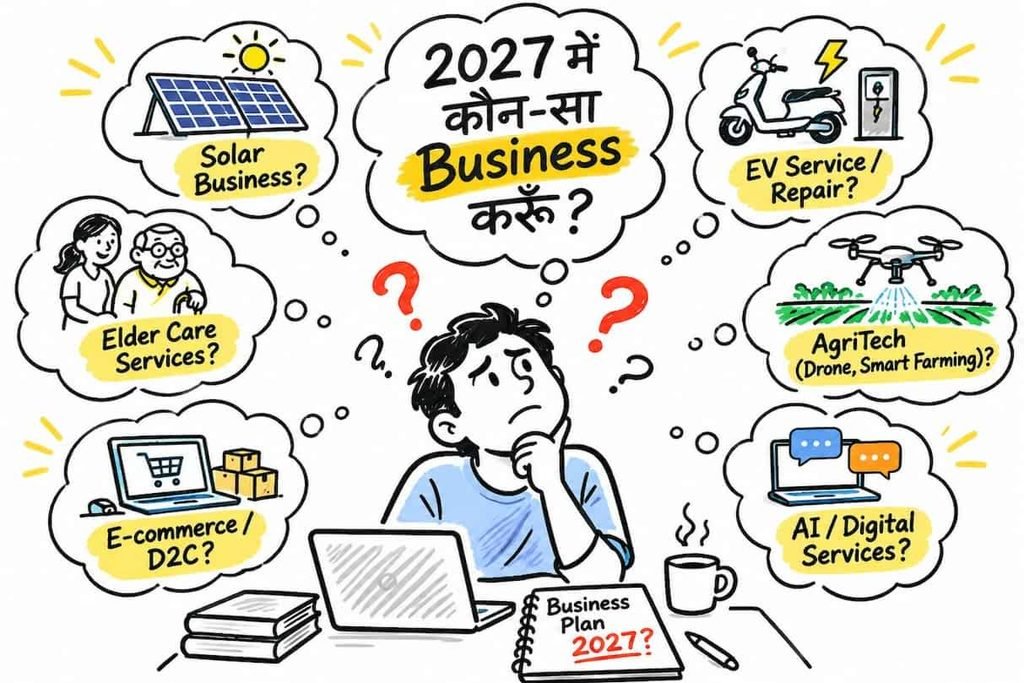
The Five at a Glance
| Business | Lean start budget | The cash trap | Why it can last |
|---|---|---|---|
| Rooftop solar installation | ₹5-15 lakh | Subsidy arrives 60-100 days late | Policy-backed demand, assets that need service |
| Home eldercare services | ₹2-5 lakh (RT estimate) | Paying caregivers before families pay you | 60+ population is doubling |
| EV two-wheeler service | ₹7-13 lakh for a 2-bay workshop | Idle bays while bikes are under warranty | The fleet grows every month |
| AI automation for small businesses | ₹30,000-1 lakh (RT estimate) | Slow first clients, price pressure | Small businesses run on WhatsApp |
| Agri-drone spraying | About ₹1.6 lakh net on an ₹8 lakh drone, after subsidy | Seasonal idle months | Subsidised drones, farmers who’d rather hire than buy |
.
1. Rooftop Solar Installation
The proof. PM Surya Ghar pays ₹78,000 on a 3 kW home system. MNRE reportedly counted 50.6 lakh installations by August 2026, against a target of one crore households. About half the target remains.
The budget. A lean installer needs ₹5-15 lakh, including ₹3-8 lakh of working capital. You’ll need DISCOM or MNRE empanelment, or your customers can’t claim the subsidy.
The math. A typical 3 kW job costs ₹1.4-1.85 lakh before subsidy. Gross margin runs 12-25%. After customer acquisition and the cost of waiting for subsidy money, one guide puts net margin at 5-8%, or ₹9,200-14,200 per job. Ten jobs a month is roughly ₹0.9-1.4 lakh net.
The trap. Cash. The subsidy reaches the customer 60-100 days after installation, so ten monthly jobs can tie up ₹8-10 lakh. Arrange a working-capital line before you scale. Annual maintenance contracts become your recurring layer.
2. Home Eldercare Services
The proof. India’s 60+ population will grow from about 100 million in 2011 to about 230 million by 2036, per PIB. CareEdge Ratings says 75% of the elderly have at least one chronic disease, and only 18% are insured.
The budget. Roughly ₹2-5 lakh (RT estimate) covers background verification, a basic office, marketing and one or two months of float.
The math. Families pay about ₹18,000-35,000 a month for a live-in attendant. One rival marketplace says agencies add 20-30% on top. Twenty families at ₹25,000 and a 20% margin is about ₹1 lakh a month gross, before your costs.
The trap. Trust and retention. Caregivers leave, and families judge you on the worst day. Keep to non-clinical attendant care unless you employ qualified nurses. Physio and nursing visits become your growth layer.
3. EV Two-Wheeler Service
The proof. October 2026 saw 3.54 lakh EVs sold, up 51% year on year. Electric two-wheelers hit 2.24 lakh, up 48%. Growth isn’t a straight line, though: two-wheeler penetration dipped to 9.65% from 11.58% in September, as festive petrol-bike discounts kicked in. One research firm forecasts the EV two-wheeler servicing market growing from $180 million in 2026 to $1.12 billion by 2033. That is a forecast, not a fact.
The budget. A small two-wheeler workshop with two bays costs ₹7-13 lakh all-in. That includes ₹1-5 lakh for diagnostics and ₹1-3 lakh for stock and working capital. You may qualify for PMEGP’s 15-35% capital subsidy on projects up to ₹20 lakh, so check eligibility.
The math (illustrative). Eight bikes a day at a ₹700 average bill over 26 days is about ₹1.46 lakh a month in revenue. Rent, a technician and parts come out of that.
The trap. Warranty. New EVs mostly go to company service centres, so independent shops win as bikes age out of warranty. Use 2027 to build skills and reputation. Guides report a shortage of trained EV technicians.
4. AI Automation for Small Businesses
The proof. Small businesses live on WhatsApp. Off-the-shelf WhatsApp bot platforms cost ₹999-2,999 a month. Custom AI agents cost ₹20,000-75,000 one-time, plus ₹3,000-10,000 a month. Those are the prices you can charge, or must beat.
The budget. A laptop and tools cost ₹30,000-1 lakh (RT estimate). Your real budget is six months of your own living costs.
The math (illustrative). Ten clients at a ₹5,000 retainer is ₹50,000 a month, recurring. Two setups a month at ₹25,000 adds another ₹50,000.
The trap. A low moat. Platforms keep absorbing basic chatbots. Sell an outcome, such as missed enquiries answered or appointments booked. Pick a niche like clinics, coaching or property. Charge retainers, not one-offs.
5. Agri-Drone Spraying
The proof. Namo Drone Didi gives women’s self-help groups an 80% subsidy up to ₹8 lakh, with a target of 15,000 drones. Under SMAM, individual farmers can get 50% up to ₹5 lakh. Service rates run ₹300-700 per acre.
The budget. A 10-litre drone costs ₹2.5-6 lakh, and a 20-litre one ₹5.5-10 lakh. After an 80% subsidy, an ₹8 lakh drone costs about ₹1.6 lakh. You also need a DGCA remote pilot certificate, with 5-10 days of training.
The math (illustrative). Ownership beats hiring only at roughly 1,000+ acres a year. At ₹450 an acre, 1,500 acres is ₹6.75 lakh gross a year. Online income claims range from ₹1 lakh to ₹18 lakh a year. Utilisation decides which end you land on.
The trap. Seasons. Spraying comes in windows, with idle months between. Battery wear and travel between farms eat the margin.
How to Pick Yours
- How many months can you survive on zero profit? Under six, lean towards AI services or eldercare. Solar and EV need more cash.
- Do you have a skill or a contact? An electrician, a mechanic, a farmer network or a nursing contact is a head start.
- Where do you live? Solar and EV suit cities and towns. Drones suit farming belts. AI works anywhere. Eldercare works where families have scattered.
RT Decision Frame
Start the one where you can survive a year of cash gaps. Test it for 90 days with real customers before you buy equipment. Don’t borrow for stock until three customers have paid you. This is a reading of the evidence, not a recommendation.
Pehle grahak, phir paisa — bina grahak ke sapna sirf kharcha hai. (First the customer, then the money. A dream without customers is only an expense.)
Plan for 6 months, and month 60 takes care of itself.
— okhvicky
Research Sources
- PIB — elderly population backgrounder
- JMK Research — India EV monthly report, October 2026
- Qbits Energy — real unit economics of an Indian solar installer
- Quickest Estimate — solar business capital needs
- BW Businessworld — CareEdge eldercare report
- Zynteq — AI automation pricing for Indian small businesses
- Bharat Skytech — agri-drone prices and subsidies
.
Share to GROW!