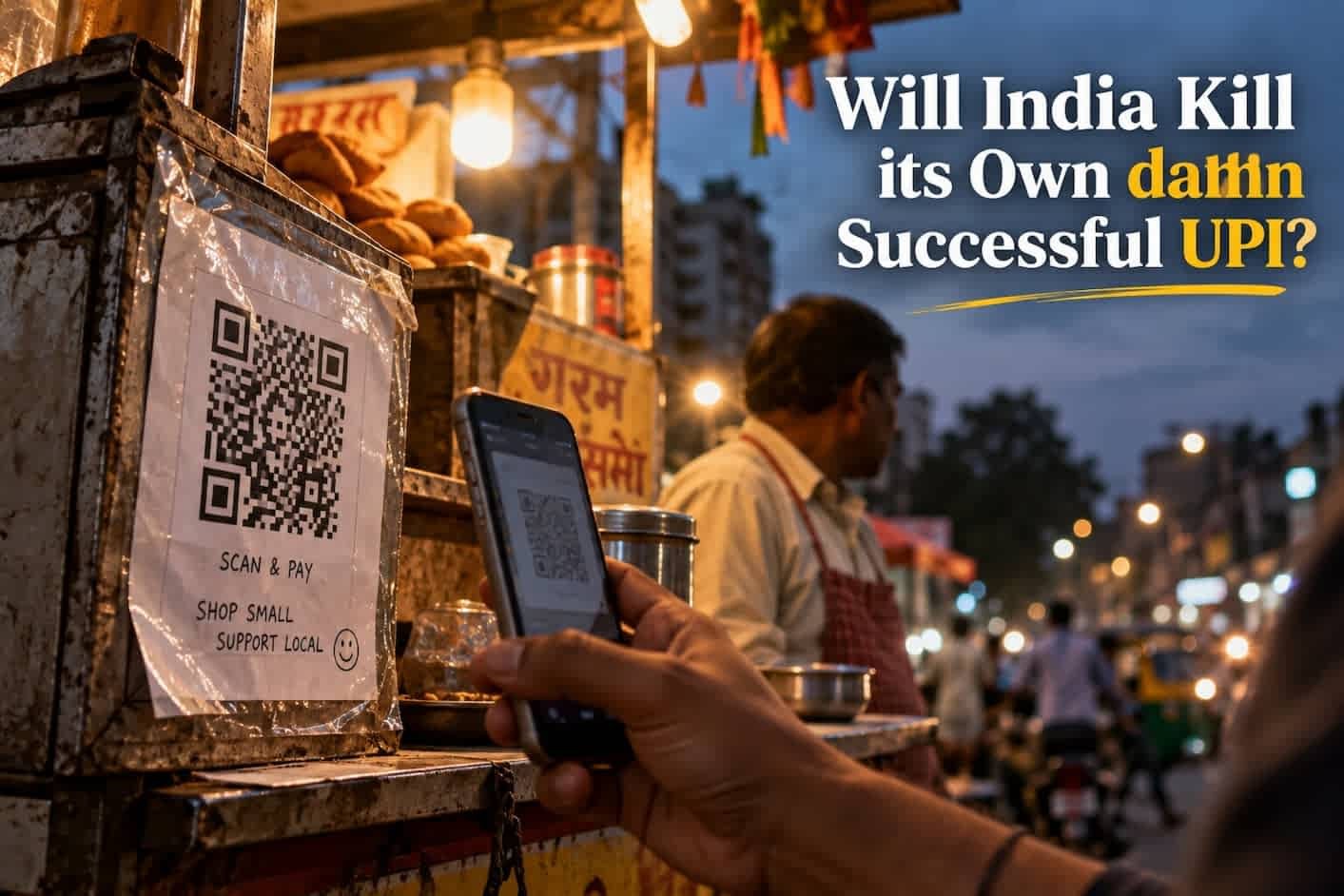
Will India Kill its Own damn Successful UPI?
India’s New UPI MDR Charge will Kill Digital Payments – Says Ashneer Grover
Amidst the stresses of daily life, its itself self concerning move by govt. of India lit upon.
RT clears up all confusion regarding what MDR is, whom it affects and whom it doesn’t, how the percentage of the charge is determined, and what its actual impact is on ordinary citizens and business owners.
RT VERDICT: small today, dangerous as precedent
New MDR, effective Oct 15, 2026
0.4%
Capped at ₹300, only on select merchant UPI above ₹2,000
Does it affect small daily UPI use? — Not yet
UPI’s real operating cost vs budget
₹20,700cr vs ₹2,000cr
Government’s own stated gap
TIME — Reconsider before October 15
Retail inflation, August 2026
4.82%
Nearing RBI’s 5-6% tolerance ceiling
The Charge Nobody Noticed You’re About to Pay For
Every time you scan a QR code to pay the vegetable vendor, you have no idea what fire the country is walking through — crude oil crossing $100 a barrel, America threatening a 100% tariff on anyone still buying Russian oil, retail inflation creeping toward 5%.
And in the middle of all that pressure, the government’s answer to funding one of its own most-praised achievements is to start charging for it.
The so called MDR (Merchant Discount Rate) has shown up as new fancy name of TAX on UPI.
What’s Actually Happening — No Confusion Left
Parliament passed the Taxation and Other Laws (Amendment) Bill, 2026, amending Section 10A of the Payment and Settlement Systems Act, 2007 — the same section that made UPI free in the first place.
From October 15, 2026, a 0.4% MDR, capped at ₹300, applies to select UPI merchant transactions above ₹2,000. Finance Minister Nirmala Sitharaman has clarified this is to be borne by the merchant, not the customer. Small daily UPI use — your chai, your groceries, most peer-to-peer transfers — stays untouched for now.
The Line That Should Bother You More Than the Charge Itself
In April 2025, the Finance Ministry called MDR-on-UPI rumours “completely false, baseless, and misleading.” In June 2025, it repeated that denial almost word for word. Fourteen months later, it’s law.
That reversal — not the 0.4%, itself — is the actual reason to distrust every “don’t worry, it’s small” reassurance being offered today. A camel’s nose is still small.
Why Now — The Government’s Real Argument, Stated Plainly
To be fair to the other side: NPCI processed over 2,451 crore UPI transactions worth ₹29.9 lakh crore in August 2026 alone.
Running that at zero cost to anyone isn’t free — the government’s own figures put UPI’s operating cost near ₹20,700 crore against a budget allocation of just ₹2,000 crore. Five percent of whatever MDR is collected is earmarked to expand UPI infrastructure.
PhonePe’s leadership has publicly backed the move on exactly this ground: a system running a ₹18,700 crore shortfall every year isn’t infinitely sustainable on goodwill.
That’s a real number. It deserves to be said plainly, not dismissed.
Why the Fix Is Worse Than the Problem It Claims to Solve
But look at what this fix actually risks, against a country that spent six years training 190 crore transactions a month into a card-free, cash-free habit:
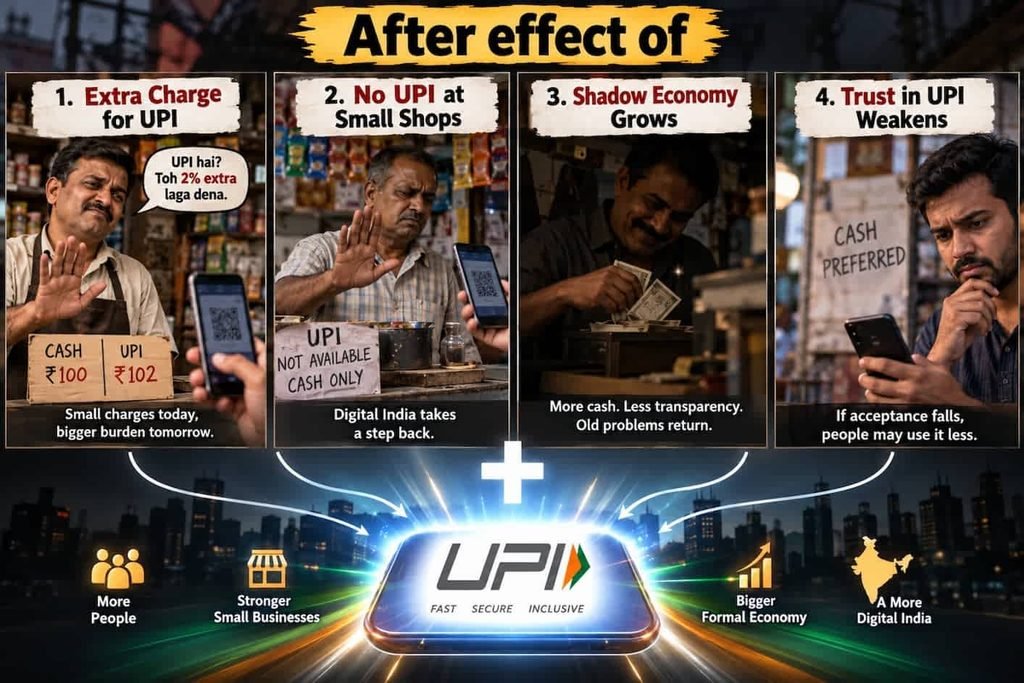
- The pass-through is inevitable. “Merchant-borne” sounds clean on paper. In practice, a shopkeeper running 2-4% margins doesn’t absorb a new cost quietly — it shows up as a slightly higher price, a “cash discount,” or a soft push back toward cash. The charge lands on the customer anyway, just with an extra layer of pretending it didn’t.
- It reopens the door to the shadow economy. UPI’s biggest unpriced achievement wasn’t convenience — it was pulling small-shop transactions out of cash and into a traceable system. Every rupee of friction reintroduced is a rupee of incentive to go back to cash, back to under-the-counter, back to the exact black-money channel demonetisation was supposed to close.
……
- Unavoidable Loop – The reality is that if the government charges businesses 1%, they pass on a 5% cost to the consumer; you would have observed this under both the old tax system and the current GST regime. So, wasn’t it obvious that if they had to pay 0.4% for UPI transactions, they would quietly add an extra 1–2% or even 4% to the price of their products?
- It undercuts the one story India tells the world about itself in fintech. Estonia, Singapore, and the G20 have studied UPI as a model. You don’t get to be the global reference case for free instant payments and simultaneously start metering it the moment the budget gets tight.
If…..
- The opportunity-cost question is fair to ask. A government finding ₹2,000 crore is short for the payments rail nearly a billion citizens use daily, while continuing free electricity units, subsidised bus fares, and direct cash transfer schemes running into thousands of crores in several states, owes citizens a real answer on sequencing — not a rebuttal that the two budgets are unrelated. They come from the same treasury.
- The system it’s protecting has its own waste to fix first. India’s ATM network is widely flagged in banking-cost studies as one of the most expensive-to-maintain, most underused legs of the payments system relative to UPI’s own efficiency. If the goal is genuinely a self-funding payments ecosystem, the housekeeping starts with the most expensive infrastructure, not the cheapest and most-used one.
RT Decision Frame
NOT NOW. Not at ₹2,000 crore short, not fourteen months after an explicit public denial, not while inflation is already testing 5% and oil is already testing $100.
The government’s cost argument is real — but a 0.4% charge introduced this way, on the back of a broken promise, spends more public trust than it raises in revenue.
If Govt. Really want to save UPI (the future of India’s fintech) — it must keep it running free and can sacrifice a few things.
- Govt. can stop lakhs crores worth of money spend as freebies to create voter base.
- Stop giving free electricity, waters, transportation to non taxpayers.
- Kill its own ATM vending machine services that is in loss of 30k crores to keep running UPI free for many years.
October 15 is still weeks away. That’s enough time to reconsider before the precedent, not the ₹300, becomes the real cost.
Research Sources:
- AdvisioTech — full MDR structure, NPCI cost data, PhonePe’s defense
- BusinessToday — Ashneer Grover’s reaction and FM Sitharaman’s clarification
- South Asian Herald — Russian oil tariff threat and August retail inflation data
1 Share to Save India’s Proud – UPI