Why People Started Hating Mohandas Karamchand Gandhi?
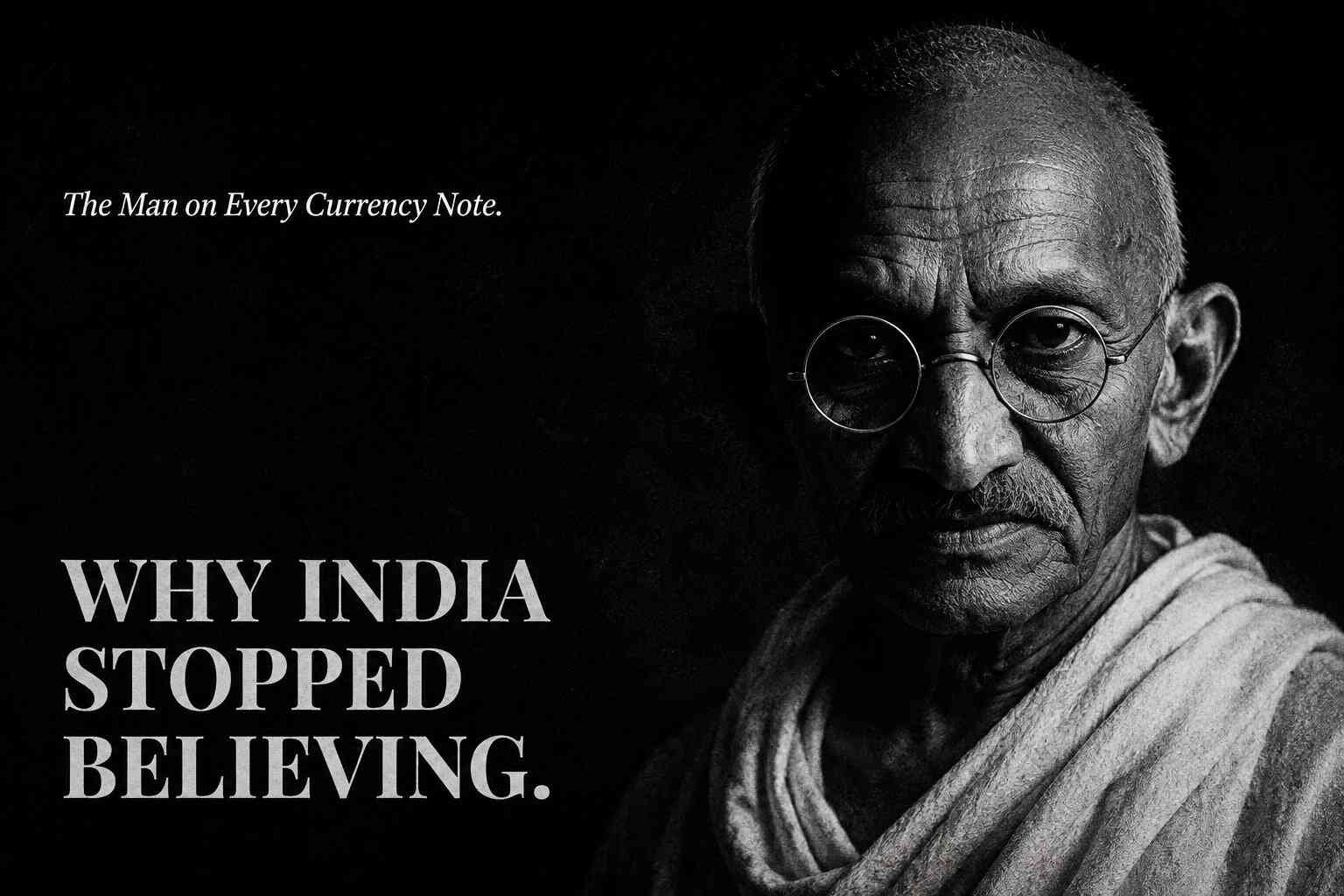
We grew up with his face on every currency note. His quotes on every classroom wall. His name on every road in every city. And yet — a whole generation of Indians today is questioning him. Loudly. Angrily. Sometimes unfairly. But not entirely without reason.
RT STANCE
Freedom was never one man’s alone
IS THE HATRED FAIR?
Partially — much is distorted
WHAT RT DOES HERE
Separates evidence from WhatsApp history
Let us start with something honest
Every civilisation eventually turns around and looks hard at its heroes. Not to destroy them — but because it has grown enough to ask harder questions. India is doing that right now with Gandhi. And honestly? That is not a bad thing. A nation that cannot question its own mythology is a nation that is still afraid of the truth.
But here is the problem. The anti-Gandhi wave sweeping through social media, WhatsApp groups, and YouTube comment sections today is not all honest inquiry. A lot of it is political. A lot of it is manufactured. And a lot of it takes real facts out of context and turns them into something they are not.
So let us do what RT always does. Look at the actual evidence. All of it. Uncomfortable on both sides.
The South Africa chapter — the hardest truth to sit with
Here is something that genuinely happened. Between 1893 and 1910, the young Gandhi in South Africa used deeply racist language against Black Africans. It is in his own writings. It is in the Collected Works of Mahatma Gandhi — an official Indian government publication. In 1896 he wrote that Indians were being degraded to the level of what he called “the raw Kaffir.” Also in same 1899 he wrote that Indians are “infinitely superior” to Black Africans. In 1904 he lobbied for racial segregation between Indians and Black Africans.
These are not WhatsApp forwards. These are primary sources. The University of Ghana removed his statue in 2018 citing these exact writings. That happened.
And here is the other side — equally true. Nelson Mandela himself wrote in 1995: “Gandhi must be forgiven those prejudices and judged in the context of the time and circumstances.” Gandhi evolved substantially. The man who left South Africa in 1914 was not the same man who arrived in 1893. He returned to India, led a movement rooted in dignity and equality for all, and was eventually assassinated by a man who thought he was too protective of Muslims and was the prime partitioner. Both the early racism and the later evolution are real. You do not get to pick only one and call it history.
Bhagat Singh — the wound that has never healed
Ask any young Indian why they are angry at Gandhi, and Bhagat Singh’s name will come up within the first minute. The charge is this: Gandhi could have saved him. He didn’t. He chose the Gandhi-Irwin Pact over Bhagat Singh’s life.
Here is what the documents actually show. Gandhi formally demanded the commutation of Bhagat Singh, Rajguru, and Sukhdev’s death sentences as part of his negotiations with Viceroy Irwin. It was on the table. Subhas Chandra Bose had told Gandhi directly that they should, if necessary, break with the Viceroy entirely on this question. Gandhi did not break. He accepted the Pact. Bhagat Singh was executed on March 23, 1931.
Was it betrayal? The evidence does not support that word. Was it a failure of will — choosing a political agreement over a non-negotiable moral demand? That is a fair question. As one historian put it plainly: if Gandhi had made commutation of Bhagat Singh’s death sentence a hard condition of the Pact, he would have become the hero of revolutionary India. He chose differently. History recorded it. The anger about it is real. And it is not entirely unjust.
The Partition — the charge Gandhi himself would have rejected most
Gandhi opposed Partition until the very end. This is not in dispute among serious historians. He was not at the Independence Day celebrations on August 15, 1947. But was in riot-torn Bengal, fasting, trying to stop Hindus and Muslims from killing each other. He wept over what happened. He called it the tragedy of his life.
And yet — Foreign Affairs published a careful 2017 analysis noting that Gandhi cannot be entirely absolved of contributing to the conditions that made Partition possible. His use of Hindu religious vocabulary in political mass mobilisation. The Khilafat movement’s collapse. The alienation of Muslim political leadership over decades. These were real dynamics. They did not cause Partition alone. But they were part of the story. Partial responsibility — not the cause. That distinction must be held clearly.
A SHORT OSHO TAKE — ON RECORD
“I have looked deeply into his life and he is one of the most violent men this century has known. But his violence is very polished — so sophisticated that it looks almost like non-violence. It comes from the back door, never the front. I loved his truthfulness. He never lied. But his whole philosophy of life was absolutely disagreeable to me.”
— Osho (Shree Rajneesh), recorded discourses. Source: Osho News archives
Osho is not calling Gandhi a liar or a fraud. He is pointing at something subtler — that moral authority used as political pressure is still a form of coercion. Gandhi’s fasts were not only spiritual acts. When he fasted over the Poona Pact in 1932 to oppose Ambedkar’s demand for separate electorates for Dalits, Ambedkar had no real choice but to capitulate. Gandhi called it satyagraha. Ambedkar called it a political gun held to his head. Both men believed deeply what they said. That is precisely what makes it so complicated.
The evidence — for and against, honestly
| THE CASE FOR GANDHI | THE CASE AGAINST GANDHI |
|---|---|
| Mass mobilisation at historic scale — brought farmers, women, merchants, and the poor into the freedom movement. No other leader achieved this without an army or a weapon. | Silenced radical voices — non-violence as the only acceptable resistance delegitimised Bhagat Singh, Subhas Chandra Bose, and those whose methods were arguably more effective. |
| Formally demanded Bhagat Singh’s clemency — the written record of Gandhi-Irwin negotiations confirms this. The “deliberate betrayal” narrative is not supported by documents. | Chose the Pact over the life — he had the leverage to make clemency non-negotiable. He did not use it. That choice belongs to him. |
| Opposed Partition completely — refused to celebrate August 15, 1947. Spent his final months trying to prevent the bloodshed nobody else would walk into. | Documented racism in South Africa — primary source evidence from the Collected Works of Mahatma Gandhi (CWMG). His own words. Not interpretations. |
| Global moral legacy — directly inspired Martin Luther King Jr. and Nelson Mandela. The UN declared October 2 International Day of Non-Violence. His methods outlived the British Empire. | Blocked Ambedkar’s demand for Dalits — the 1932 fast over the Poona Pact used moral authority as coercion. Ambedkar documented this clearly and never forgave it. |
| Personal integrity — always — even his sharpest critics, including Osho, acknowledged he never lied. He was ruthlessly consistent with his own principles, even when they hurt him. | Freedom’s credit concentrated unfairly — Bhagat Singh, Bose, Savarkar, the INA, the 1946 Royal Indian Navy Mutiny — all compressed into footnotes in a story that was later told with one man at the centre. |
India’s Freedom: Never a Solo Act
Here is something worth sitting with quietly for a moment.
Bhagat Singh died at 23. He had written more clearly about justice, imperialism, and the Indian future than most people twice his age. Subhas Chandra Bose built an army from Indian prisoners of war across Southeast Asia and led them toward the border of British India. His story ended in circumstances still officially unresolved. Savarkar spent years in the Cellular Jail in the Andamans writing petitions on the wall with a nail because they would not give him paper.
These men were not supporting actors. They were architects of a different kind of freedom — one that moved through sacrifice, rage, and a refusal to be civilised about injustice. Britain’s own Prime Minister Clement Attlee stated explicitly in 1956 that Subhas Chandra Bose’s INA had done more to end British rule than Gandhi’s civil disobedience campaigns. The 1946 Royal Indian Navy Mutiny — 20,000 sailors across 78 ships refusing to serve the Crown — shook the colonial administration at its structural core.
Gandhi did not erase these men. The Congress Party’s textbook writers did. That injustice belongs at their door — not entirely at his.
RT VERDICT — A PERSONAL POSITION
Gandhi was not a villain invented by political revisionism. He was a genuinely extraordinary human being — flawed, evolved, contradictory, and real. The hatred spreading today online is mostly not honest historical inquiry. It is manufactured anger dressed in the costume of intellectual correction. Most of the people forwarding anti-Gandhi content have not read a single primary source. They have read a WhatsApp message.
But underneath the noise is a legitimate truth that India’s textbooks have avoided for decades: freedom was not one man’s gift to a nation. It was the collective toil of thousands — some remembered, most not, and a few deliberately compressed into footnotes by the political inheritors of a movement that was always bigger than any single name.
Bhagat Singh at the gallows at 23. Subhas vanishing mid-flight. Savarkar carving words into a prison wall because they wouldn’t give him paper. These were not footnotes. They were the fire. Gandhi was real. So were they. India is large enough to hold all of them — if only the history books were honest enough to try.
Research Sources
- Collected Works of Mahatma Gandhi (CWMG) — South Africa racism, primary source: Link
- Gandhi Study / Delhi Pact 1931 — Bhagat Singh clemency demand documented: Link
- BBC Trending — Ghana statue removal, documented writings: Link
- Osho News — Osho’s recorded discourses on Gandhi: Link
Share To a Proud Nationalist!