
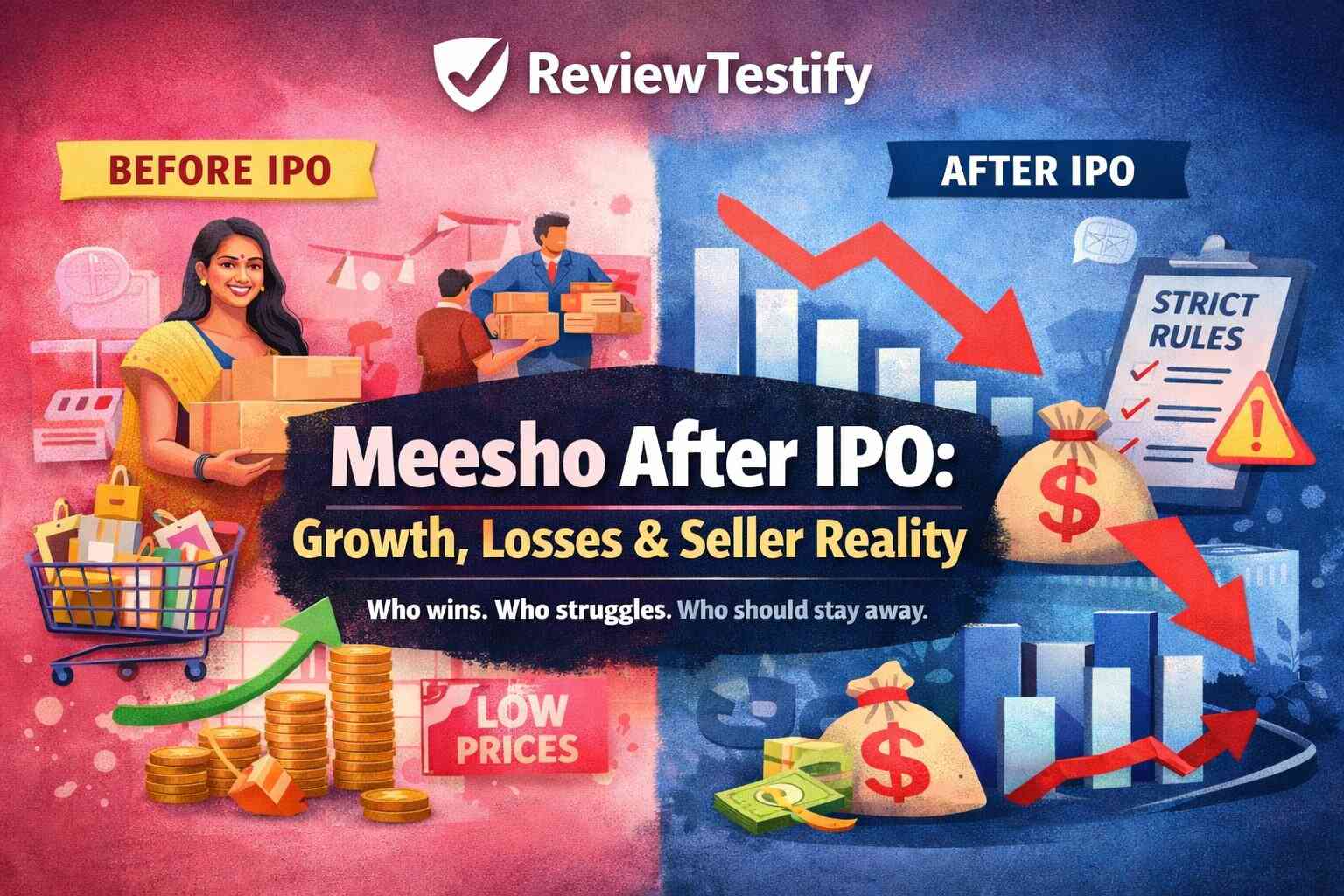
“What Happened To Meesho After, IPO?
What Really Happened to Meesho After Its IPO — And Should You Still Sell/Invest There?
In one line – Meesho’s IPO didn’t turn it into a success story overnight.
It turned it into a transparent one.
In this article, you will get clarity on Meesho, whether you should invest in it, or as a seller to sell your products or not.
Before listing, Meesho could afford chaos. After IPO, every weakness showed up on paper — revenues, losses, seller friction, all of it. That’s why understanding Meesho before vs after IPO matters if you’re a seller or brand deciding where to bet your time and money on their platform.
Meesho before IPO: growth-first, discipline-later
Earlier, Meesho was built for speedy sales where Low prices, mass-market buyers, and aggressive onboarding of sellers were the key, and it worked because India’s value-commerce demand is real.
For small sellers, Meesho felt easy:
- Orders came fast
- Entry barriers were low
- Branding barely mattered
But behind the scenes, the platform was burning cash to keep prices attractive and logistics moving. Profitability was never the priority — scale was.
Meesho after IPO: same engine, tighter controls
Post-IPO, Meesho didn’t slow down — it cleaned up.
Revenue continued to grow steadily (FY23–FY25 showed strong topline expansion). Losses, however, looked alarming — especially in FY25. The catch? A large part of that loss came from one-time IPO-related restructuring, tax adjustments, and accounting changes, not daily business collapse.
In Q3 FY26, revenue still grew ~30% YoY, while losses widened again — showing Meesho is still investing heavily to protect volume and market share.
In line:
The business is expanding, but profitability is being postponed deliberately.
What this means for sellers (the part that actually matters)
For single sellers & side-hustlers: still useful — if you’re realistic
Meesho still works if:
- Your product is low-cost and fast-moving
- You’re okay with thin margins
- You understand returns and cancellations are part of the game
Add on: -Comparing Amazon, Flipkart, and Meesho, modern consumers share one defining assumption: choose Amazon for premium quality, Flipkart for balanced pricing, and Meesho for absolute cheapness.
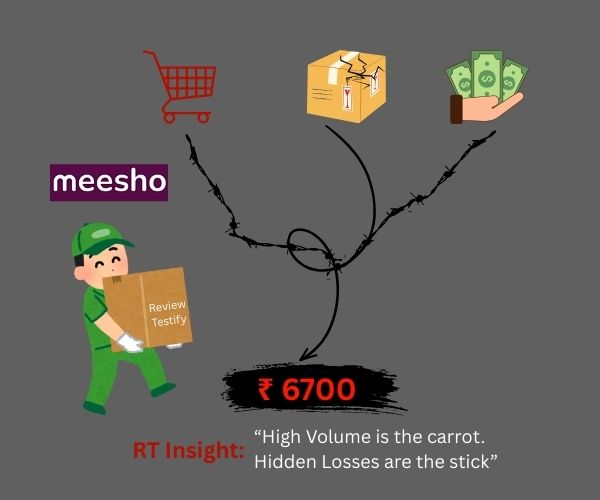
Beyond personal reality checks, I’ve discovered Meesho still grapples with widespread fake orders and unjustified RTO charges. These recurring issues inflict uncalculated losses upon sellers throughout their journey; personally, I have lost 6,700 in this manner.
Meesho’s strength is demand access. It brings buyers you won’t reach cheaply elsewhere. But operational discipline is non-negotiable now. Sellers who don’t track unit economics bleed silently.
This platform rewards people who treat selling like a system — not a dream.
For brands trying to build long-term value: mostly a bad fit
If your brand depends on:
- Pricing power
- Consistent margins
- Customer loyalty
Meesho will fight you.
The customer mindset on Meesho is price-first, brand-last. Even after IPO, the platform optimises for volume, not brand storytelling. Many brands that scaled here later struggled to charge higher prices anywhere else.
That’s not Meesho’s fault — it’s a positioning mismatch.
The quiet post-IPO shift most people miss
After IPO, Meesho became less forgiving:
- Seller policies tightened
- Cost discipline increased
- Subsidies became selective
This is good for Meesho’s survival.
It’s bad for sellers who relied on loose rules and optimism.
A simple YES / NO / NOT NOW test
Ask yourself:
- Can my product survive after logistics, returns, and price pressure?
- Am I using Meesho for volume, not brand equity?
- Can I tolerate operational mess without emotional decision-making?
- YES to all three → Sell on Meesho
- NO to even one → Avoid or delay
2 sec’ Conclusion
Post-IPO, Meesho isn’t broken; it is simply more exposed. It remains powerful for the right household sellers, particularly women, yet dangerous for the wrong brands. Use Meesho as a tool, not a foundation—a channel, not an identity.
That distinguishes complaining sellers from those quietly profiting. Before investing, Meesho must pass many more tests; until then, wait and watch.
Research & evidence sources
Business Standard, Moneycontrol, Entrackr (financials & quarterly results);
Groww & IndMoney (IPO and loss breakdowns);
Public seller experiences from Reddit and MouthShut.
Meesho supplier documentation for policy context.