
Amazon, Flipkart, Meesho: Return Reduction (2026)
Every online seller celebrates orders. Very few track what quietly destroys them — returns. You think returns are just part of business. They’re not. They are the difference between profit and illusion.
Here’s the uncomfortable truth: the customers who return the most often buy the most. So you can’t just “reduce returns” blindly — you need to understand them, control them, and use them to your advantage.
Most sellers are growing revenue while silently losing margin. Why? Because they track sales, not leakage. They don’t measure the real cost of returns, platform-wise behaviour, or how deeply returns eat into profit.
This article is not about basic tips. It’s about understanding returns like a system — how they work, why they increase, how each platform behaves differently, and how to actually reduce them without killing sales.
Because without measurement, you’re not scaling a business — you’re scaling mistakes.
Returns are fundamentally about trust—the customer’s belief that they won’t be stuck with a mistake.
Pierre Omidyar, the founder of eBay
Returns: The Hidden Cost of Destroying Your Profit
Most sellers treat returns like a customer-service problem. That is a mistake. In e-commerce, returns are a margin problem first. Shopify says the average ecommerce return rate was 16.9% in 2024, and the cost to process a return can be 20%–65% of the item’s original value. Easyship also notes returns have become an industry norm, with some sectors far higher than average, and Invesp’s long-running data shows online returns can be around 30%, much higher than brick-and-mortar.
That is why high-return customers are not always “bad customers.” Often, they are high-intent buyers who shop more, compare more, and bracket more — buying multiple sizes or variants and sending some back. Shopify and Narvar both point to returns being driven by mismatch, fit issues, and expectations that were not met.
Platform-Wise Return Reduction Strategy (Amazon, Flipkart, Meesho)
On Amazon, the fastest fix is not “beg customers not to return.” Amazon’s Seller Central gives ASIN-level return visibility through the Returns & Recovery / Returns Insights tools, and Feedvisor notes the dashboard is updated three times a week. Use that data to fix the real cause: bad images, weak size charts, vague descriptions, poor Q&A, or products that are not as described. Amazon’s own help pages also separate return handling and refund workflows, which means sellers need to track returns, not just sales.
On Flipkart, the return policy is category-specific. Some products are 7-day returns, some are 10-day returns, and some large appliances are replacement/repair only. Flipkart also states that, in many cases, the final decision on defective-device replacement rests with the seller or brand. In plain English: your listing promise must match the category policy, or returns will punish you.
On Meesho, return options are also product-specific. The platform separates wrong/defective-item returns from all return options, and only some products qualify for broader return flexibility. Meesho’s policy also shows that refunds and return eligibility depend on the return reason and product category. That means the seller must keep stock accuracy, packaging quality, and product condition tight.
If you sell from your own website, you have more control, but also more responsibility. Easyship recommends exchange or store-credit offers, strong packaging, and asking buyers why they returned the product so you can fix the real reason. Shopify’s reverse-logistics guidance adds that a customer-friendly returns flow reduces friction and protects trust.
RRR (Real Return Ratio): The Only Metric That Shows Real Profit
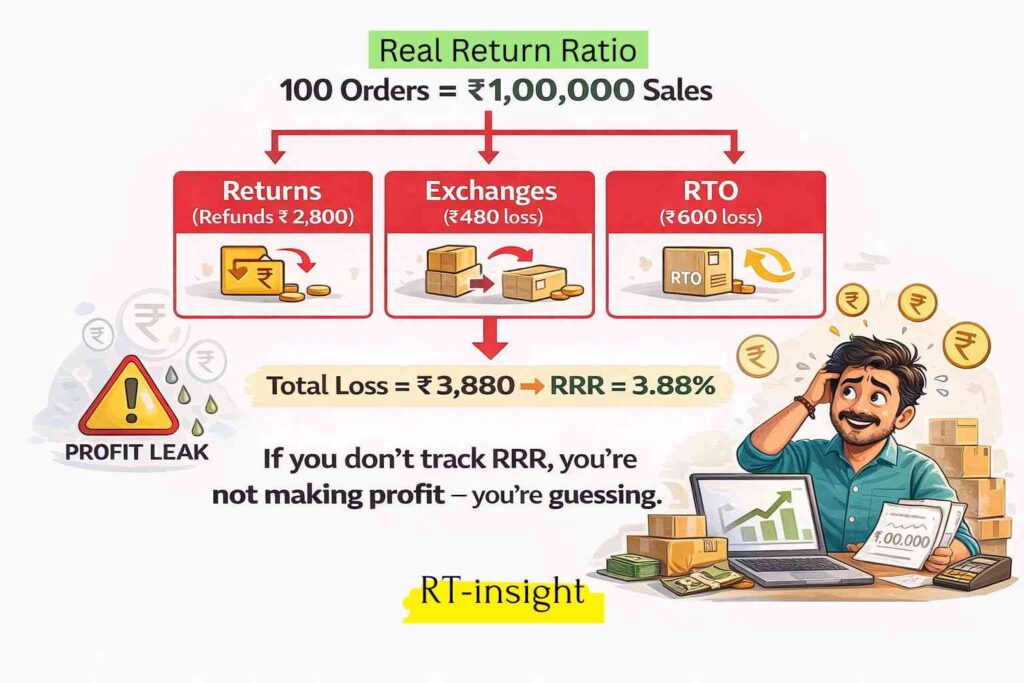
RT’s working metric is RRR = Real Return Ratio. Do not confuse it with the simple return rate. Return rate only tells you how many orders came back. RRR tells you how much money the return problem is burning.
Formula:
RRR = Total return-related cost ÷ Gross sales × 100
Easy example:
100 orders × ₹1,000 = ₹1,00,000 sales
Returns create ₹3,880 of total leakage:
₹2,800 from 8 cash refunds, ₹480 from 4 exchanges, ₹600 from 3 RTOs.
So RRR = 3,880 ÷ 1,00,000 × 100 = 3.88%
If your gross margin is 20% and your RRR is already 8% or 10%, you are not scaling profit. You are scaling waste. That is the trap most sellers miss because they track revenue, not leakage.
How is RRR different from the normal return rate?
RRR is not a new formula. It’s a better way to see your losses.
Return rate only shows how many orders came back.
RRR shows how much money those returns actually cost you.
Example:
SKU A has 10 returns out of 100 orders, but each return costs ₹20.
SKU B also has 10 returns out of 100 orders, but each return costs ₹120 because of shipping, packing, and replacement.
Same return rate, but very different losses.
That’s the real insight.
RRR helps you see which product, platform, or category is hurting your profit the most.
So it’s not about complex math — it’s about tracking real damage, not just counting returns.
The RT path to profitability
Reduce returns at the source: better photos, better sizing, better packaging, tighter catalogue accuracy, and cleaner policies. Then watch RRR every month. If it falls, profit rises. If it rises, growth is fake. Bezos’ blunt line — “Your margin is my opportunity” — still applies, because every weak margin is a target for returns, discounts, and competition.
+ve Note: returns will never disappear. But sellers who measure them properly, fix the cause, and set the right price will survive. The rest will continue to confuse sales with profit.
Research & Evidence Sources
- E-commerce average return rate ~16.9% and return cost up to 20–65% of product value
https://www.shopify.com/enterprise/blog/ecommerce-returns - Up to 30% online products are returned vs ~9% offline
https://www.invespcro.com/blog/ecommerce-product-return-rate-statistics/ - Industry return rates range 17–20%, higher in fashion (30–40%)
https://redstagfulfillment.com/average-return-rate-for-a-shopify-store/ - Returns rising globally, reaching ~17% of retail sales value
https://www.returnprime.com/blog/e-commerce-return-trends
Share & See the Magic!