
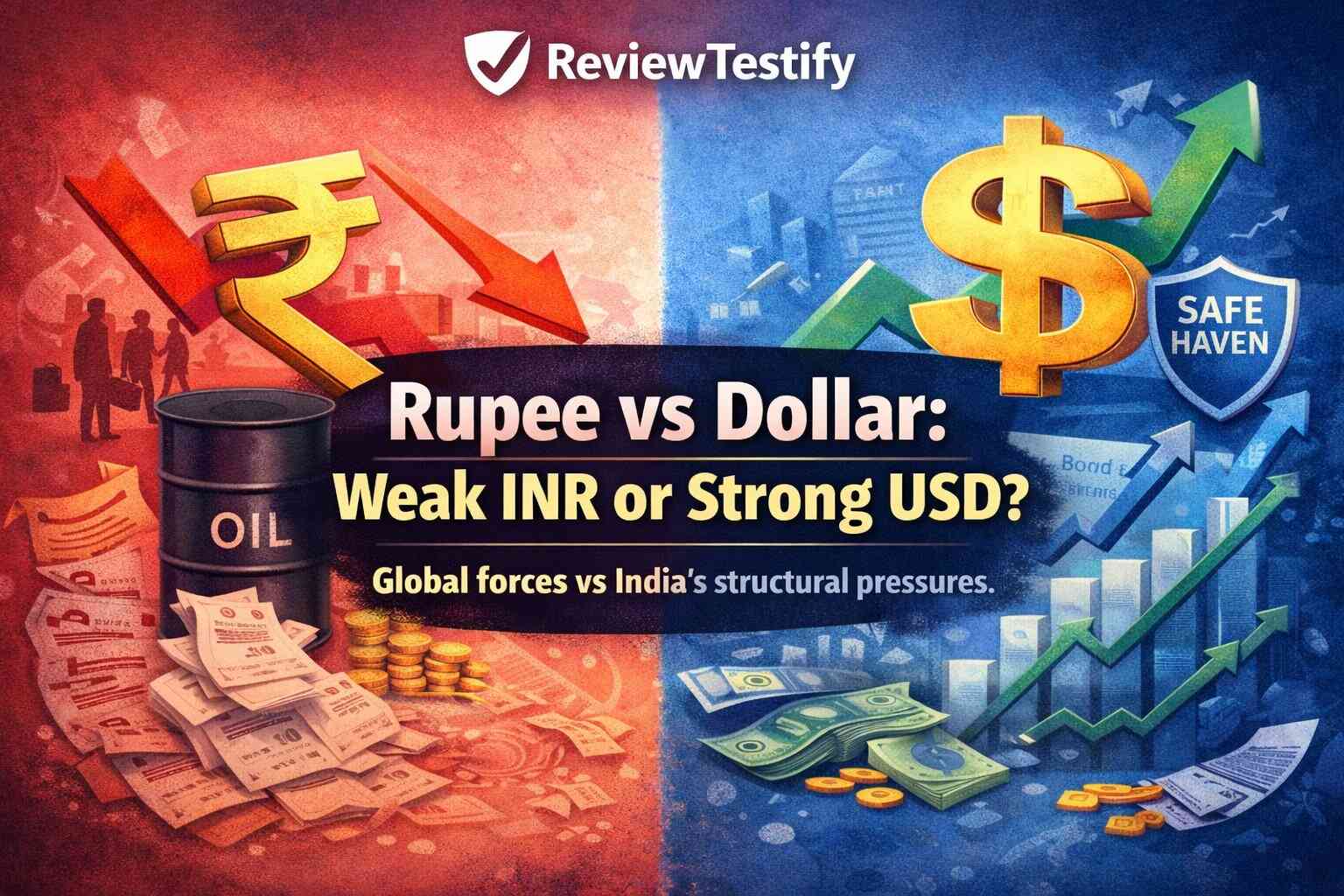
Rupee vs Dollar: INR Weak or the USD Strong?
Rupee vs Dollar: Is the INR Weak — or Is the USD Simply Dominating?
India’s economy is growing fast. GDP growth has stayed above 7% across multiple quarters in 2025. Inflation has cooled sharply, even flirting with deflation in food prices.
On paper, this looks like economic strength. Yet the rupee is hovering near historic lows against the US dollar.
This contradiction raises a real question:
Is the rupee weak — or is the dollar too strong?
Let’s break this down in this ‘hen or egg first’ article without noise.
Why a growing economy can still have a falling currency
Currency strength is not a trophy for GDP growth. It reflects capital flows, trade balance, interest rates, and global risk sentiment.
India’s growth is real. But so are its structural pressures:
- India imports far more than it exports.
- Oil, electronics, machinery, and gold are priced in USD.
- When the rupee falls, the import bill rises immediately.
Growth increases demand for imports.
If exports don’t grow at the same pace, the currency comes under pressure.
The RBI’s rate cuts: good for growth, bad for the rupee
With inflation falling below target, the RBI cut repo rates multiple times in 2025.
Lower rates:
✔ Encourage borrowing and spending
✘ Reduce returns on Indian bonds
Foreign investors compare yields globally. If US bonds offer better returns, money moves out of India.
When investors exit:
They sell rupees → buy dollars → INR weakens.
This is not a crisis. It’s basic capital flow math.
The global dollar effect: when the tide pulls everyone down
Even strong economies cannot escape a strong dollar.
The USD strengthens when:
- US bond yields are high
- Global uncertainty rises
- Investors seek safety
In such periods, all emerging market currencies weaken, regardless of domestic growth.
The dollar has a dual role:
- Investment currency
- Global safe haven
If the US slows and the Fed cuts rates, the dollar may weaken.
But if global fear rises, money still rushes into USD — pushing emerging currencies down.
India is caught in this crosscurrent.
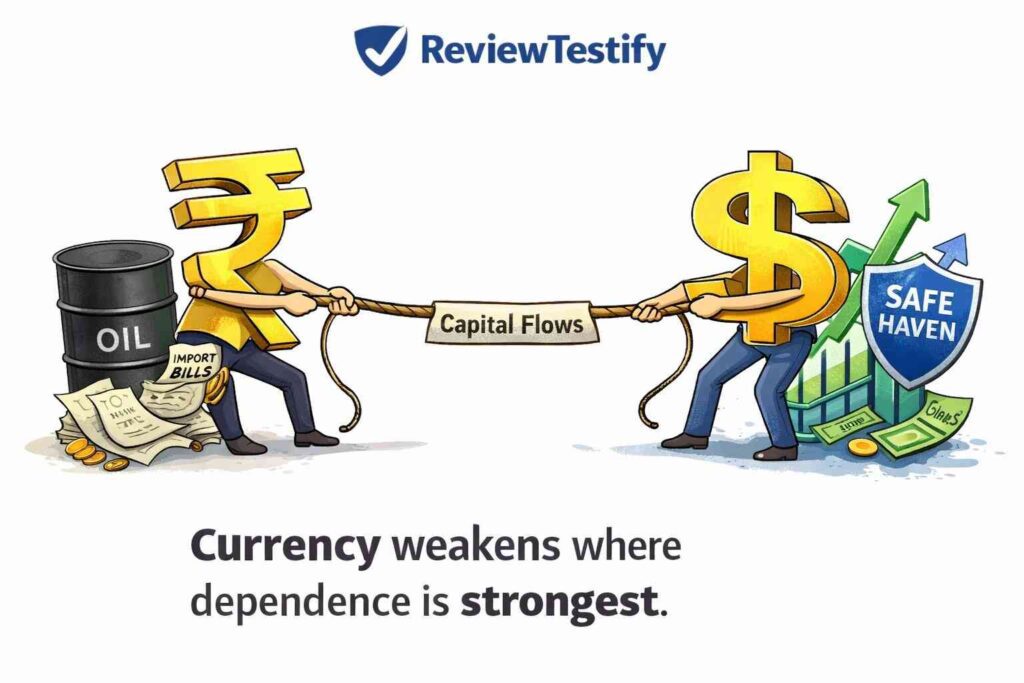
India’s homegrown pressure points
Not all rupee weakness is external.
1. Trade deficit
India imports heavily, but exports grow slowly. This widens the deficit and weakens the currency.
2. Oil dependence
Crude oil is India’s biggest vulnerability.
A weaker rupee makes oil costlier — instantly raising national expenses.
3. FII behaviour
Foreign investors care about USD returns.
If they earn 10% in India but the rupee falls 3%, their real return is 7%.
Persistent rupee weakness triggers capital outflows, which further weaken the rupee.
This feedback loop is already visible in sustained FII selling.
What a weak rupee actually means for Indians
This isn’t abstract economics. It hits daily life.
Costlier essentials
- Fuel and transport
- Imported electronics
- Flights and international services
- App subscriptions priced in USD
Gold becomes expensive
Indians buy gold as a hedge — not just against inflation, but against currency depreciation.
Export benefits are limited
Only sectors with minimal import dependence — like IT services — benefit cleanly.
Manufacturing exporters often lose the advantage due to higher input costs.
The strange mix: high growth + low inflation
Near-zero inflation typically signals weak demand.
India, however, is seeing strong growth alongside falling food prices.
This suggests:
- Sector-specific price declines
- Strong services growth
- Statistical deflation, not economic weakness
In short: the economy is expanding, but the currency reflects structural gaps.
Final verdict: Weak rupee or strong dollar?
Both are true.
The dollar is strong due to global forces.
The rupee is pressured by structural realities:
- import dependence
- trade deficit
- capital outflows
This is not a verdict on India’s economy.
It’s a signal of where vulnerabilities still exist.
What matters next
The rupee’s path depends less on GDP headlines and more on structural shifts:
- Reducing oil dependence
- Boosting export competitiveness
- Deepening manufacturing
- Stabilizing capital flows
Until then, the rupee will remain sensitive to global tides — even when India grows faster than everyone else.
Research & Evidence Sources
- RBI & government trade data on deficits and imports
- USD/INR depreciation trends and record lows
- FII outflows and capital flight impact
- Strong dollar, oil dependence, global pressures